Sunset Commission Comment: Aligning UI Good Cause Rules with State Statute
The full text of the comment is below. You can also view it as submitted (PDF): PFN Sunset Comment Letter (PDF).
This comment was submitted to the Texas Sunset Advisory Commission on August 17, 2026, during its public review of the Texas Workforce Commission. The Commission’s official record of the submission is available on its website: Sunset Advisory Commission submission record.
August 17, 2026
The Honorable Lois Kolkhorst, Chair
The Honorable Lacey Hull, Vice Chair
Members of the Sunset Advisory Commission
P.O. Box 13066
Austin, Texas 78711
Re: Comments on the TWC Sunset Staff Report from Policy Field Notes
Dear Members of the Commission:
My name is Blake Dodd and I am a former employee of the Texas Workforce Commission. This comment is focused on Recommendation 8.2 of the Staff Report. After conducting research on the unemployment insurance program, I found there is misapplication of state statutes regarding Commission decisions for specific instances of voluntary separations under Texas Labor Code § 207.045(d). This comment is not meant to relitigate my own case but rather to point toward an issue which denies the original intent of the statute, impacts the lives of many claimants, and produces an inefficient process of handling cases.
Delegated Powers Given to TWC
Rulemaking Authority
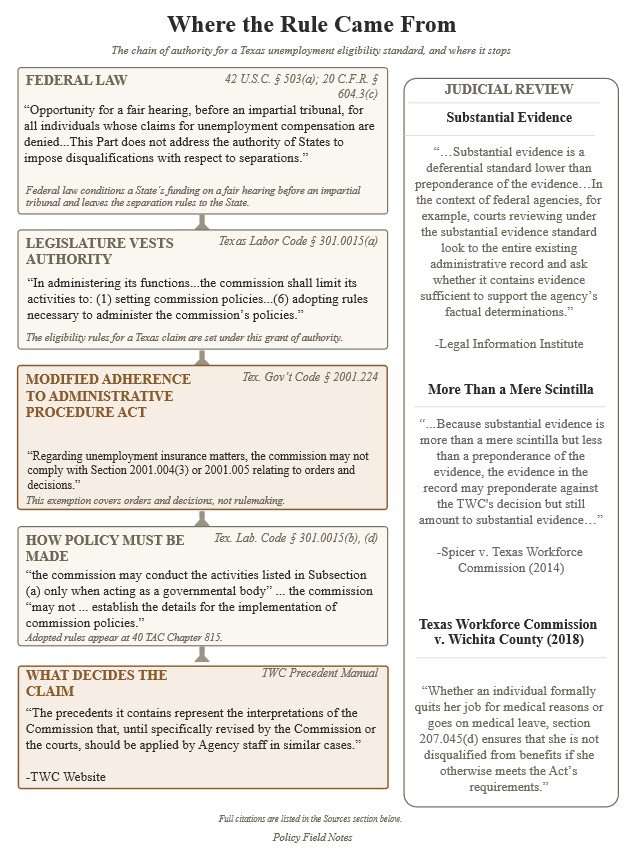
TWC is provided rulemaking authority regarding the administration of certain programs through statutes such as Labor Code Chapter 301, which sets the general rulemaking authority of the Commission. However, rulemaking authority provided to the agency over programs does not permit Commissioners to act in a way that adds to existing statute. This type of situation can occur when longstanding issues in an agency cause leadership, and thereby staff members, to operate programs in ways that are guided more by past internal decisions and behavior, rather than proper procedure and regulatory review. The Staff Report made one finding lending to behavior insulated from outside review:
- The “Commission member training” finding on page 110 states partly, “…However, statute does not contain newer requirements for all topics the training must cover such as a discussion of the scope of and limitations on the commission’s rulemaking authority…”
Being able to understand actions which stray from the original intent of a law is paramount to making systems work. The descriptions below briefly show how the misapplication of law leads to programmatic issues, thereby impacting constituents it was built to serve. Only a few specific cases are identified in this comment, but the problem occurs on a regular basis.
Good Cause Connected with the Work
A Straightforward Reading of the Statute
State statute provides instruction on how the Commission should handle claims involving certain elements of a voluntary resignation from employment:
“(d) Notwithstanding any other provision of this section, an individual who is available to work may not be disqualified for benefits because the individual left work because of: (1) a medically verified illness of the individual or the individual’s minor child; (2) injury; (3) disability; (4) pregnancy; (5) an involuntary separation as described by Section 207.046; or (6) a move from the area of the individual’s employment that: (A) was made with the individual’s spouse who is a member of the armed forces of the United States; and (B) resulted from the spouse’s permanent change of station of longer than 120 days or a tour of duty of longer than one year.”
—Texas Labor Code § 207.045(d).
The statute shown above identifies the types of conditions where a claimant is eligible for benefits. It does not add a test to the language requiring a doctor to tell a claimant to resign, and lawmakers would have included the instruction if it were their intent. This is displayed even in surrounding statute where a specific requirement was identified for an involuntary separation which included sexual assault/family violence § 207.046(a)(2)(C) or the terminal illness of a spouse § 207.046(a)(3). Similar requirements were not added to § 207.045(d).
Misapplication in Action
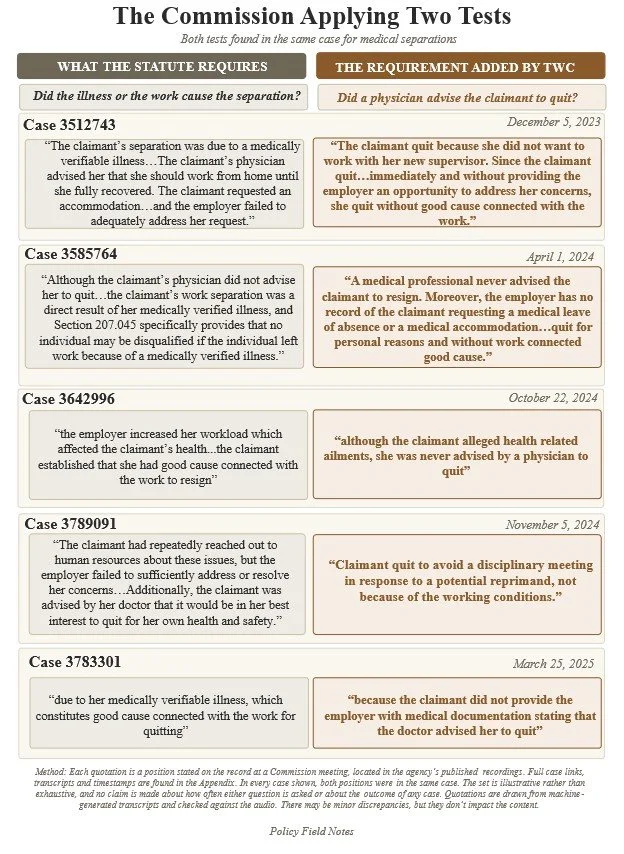
The consequences of not following the legislative intent of § 207.045(d)(1) are evident in TWC guidance materials and Commission decisions. TWC adds decisions into the Appeals Policy and Precedent Manual, and the process ends up being confusing for those who did everything they could to protect their job: visited a physician, sought accommodation, used FMLA when needed, worked with employer to address issues impacting a medically verified illness. Under the current system, a person with a disability could do everything they could to make it in a job and still get denied UI benefits if a doctor did not use the specific words about them having to resign. The result is shown in multiple decisions made in public meetings where the added test is seen continuously. The figure below displays five such decisions made on claims and focuses on the language used by a Commissioner rather than the ultimate decision. Transcripts are provided in the appendix for a fuller context.
The Judicial System Defers to Agency Rules
Courts tasked with reviewing TWC claimant decisions use the substantial evidence standard. A UI program operating on an extra test outside of the statute causes the court to accept requirements not found in the statute. The following is a definition of substantial evidence from the Legal Information Institute and a statement from a 2014 court case partly describing how a review is conducted at the court level:
“…Substantial evidence is a deferential standard lower than preponderance of the evidence…In the context of federal agencies, for example, courts reviewing under the substantial evidence standard look to the entire existing administrative record and ask whether it contains evidence sufficient to support the agency’s factual determinations.”
“…Because substantial evidence is more than a mere scintilla but less than a preponderance of the evidence, the evidence in the record may preponderate against the TWC’s decision but still amount to substantial evidence…”
—Spicer v. Texas Workforce Commission (2014)
Proposal for the Sunset Commission
Modify Recommendation 8.2 by Amending Texas Labor Code § 207.045(d)
Amend § 207.045(d) to clarify that medical verification of the listed conditions is sufficient for eligibility, and a resignation directive from a physician is not a requirement.
Without more clarity in the statute, decisions made by the Commission will continue to negatively impact those it was meant to help. This issue is important because Texans expect government institutions to run effectively and in alignment with state law. When one agency’s program fails to live up to the basic standard of a statute, it disrupts people’s experiences with the entity as a whole, places the organization in a bad light, and can lead toward a situation where leadership relies on processes running against lawmaker intentions. This is happening with the administration of TWC’s unemployment insurance benefits program and can be fixed through the Sunset process.
Respectfully Submitted,
Blake Dodd
Policy Field Notes
blake@policyfieldnotes.com · PolicyFieldNotes.com
Sources
Statutes and Regulations
- Tex. Lab. Code § 207.045
- Tex. Lab. Code § 301.0015
- Tex. Lab. Code §§ 204.022, 207.046
- Tex. Gov’t Code § 2001.224
- 42 U.S.C. § 503(a); 20 C.F.R. § 604.3(c)
- 40 Tex. Admin. Code ch. 815
Cases
- SPICER v. TEXAS WORKFORCE COMMISSION (2014) | FindLaw
- Tex. Workforce Comm’n v. Wichita Cnty. – CourtListener.com
Agency and Sunset Materials
- Unemployment Benefits - Appeals Policy & Precedent Manual - Texas Workforce Commission
- Sunset Advisory Commission, Texas Workforce Commission Staff Report, June 2026, Issue 8 and Recommendation 8.2.
Legislative History
- Act of May 1, 1995, 74th Leg., R.S., ch. 76 (S.B. 959), § 9.33 (adding Tex. Lab. Code § 207.045(h)). lrl.texas.gov (SB 959, 74th R.S. history)
- Act of 2003, 78th Leg., R.S., ch. 817 (S.B. 280), §§ 7A.03 to 7A.05 (amending Tex. Lab. Code §§ 204.022, 207.045(d), 207.046). lrl.texas.gov (SB 280, 78th R.S. history)
- Revisor’s Report, Labor Code, Texas Legislative Council, February 1993, at 458 to 460 (source law: Tex. Rev. Civ. Stat. art. 5221b-3(a)).
Commission Meeting Recordings (Figure 2 cases)
- Case 3512743 (Dec. 5, 2023): https://www.youtube.com/watch?v=1I4NA4X4IUU&t=1120s
- Case 3585764 (Apr. 1, 2024): https://www.youtube.com/watch?v=T7Xs1_CFD3I
- Case 3642996 (Oct. 22, 2024): https://www.youtube.com/watch?v=FfQ16dzxW68&t=764s
- Case 3789091 (Nov. 5, 2024): https://www.youtube.com/watch?v=Cso-82TdMw0&t=1820s
- Case 3783301 (Mar. 25, 2025): https://www.youtube.com/watch?v=U3qBvMaTm0E&t=750s
Appendix A: Case Transcripts
Case 3705157
October 21, 2025, 1:39:51 to 1:41:53.
https://www.youtube.com/watch?v=pAqHt0vL7kQ&t=5985s
Case number 3705157.
1:39:49 Commissioner Treviño: The AT decision should be modified. I do not dispute that the claimant did not establish good cause for missing AT1.
1:39:57 However, regarding the job separation, the available evidence established that the claimant’s separation occurred when the employer insisted that she return to work in the office after she had been working remotely during her pregnancy. The claimant wanted to keep her job and requested to continue working remotely, but she could not return to the office because of the medical condition of her newborn child who was born prematurely and needed both close monitoring at home and regular checkups with doctors. Therefore, since the claimant’s separation was directly related to the medical condition of her minor child, it was not a disqualifying reason under section 207.045 of the Act. Modify the AT: claimant did not have good cause for AT1; no voluntary leaving.
1:40:53 We should affirm the AT decision concerning good cause. The claimant missed the hearing when she mixed up the date of the hearing with another scheduled hearing. Since the claimant missed the hearing due to circumstances that were within her power to control, she did not establish good cause. Concerning the job separation, the claimant was separated when she did not report to work due to health concerns related to her child. Since the doctor did not advise her to resign, and moreover since the claimant quit when continuing work was available, her separation was voluntary and without good cause connected with the work. As such, we should affirm the AT decision. The claimant did not establish good cause for missing the AT hearing; voluntary leaving.
1:41:30 It appears that the claimant has submitted clear medical documentation of her minor child’s medically verified illness under section 207.045(d) of the Act. Under these circumstances, we should find good cause and resubmit for the underlying merits testimony. Therefore, modify the AT: good cause; resubmit.
1:41:46 Ma’am, I’ll agree with Commissioner Connett.
1:41:55 Thank you, sir. We will resubmit the case.
Case 3783301
March 25, 2025, 12:40 to 14:37.
https://www.youtube.com/watch?v=U3qBvMaTm0E&t=750s
12:40 Commissioner Treviño: The decision is not supportable and the claimant should be qualified for benefits whether the separation is viewed as a discharge or quit. The claimant was on unpaid FMLA leave and had not been offered a contract for the next school year even though other employees had received them. Since the claimant was not working or being paid and was not offered a contract for the following school year, the claimant was constructively discharged. Since the employer presented no real evidence of any misconduct by the claimant, the claimant was discharged for reasons other than misconduct connected with the work. Reverse the AT, no misconduct, bill reimbursing employer.
However, since the claimant submitted a resignation while she was on approved unpaid FMLA leave, the separation could be viewed as a voluntary quit. Both parties testified that the claimant resigned for personal health reasons and that her doctor suggested that she not return for the next school year while she was out on FMLA. Therefore the evidence established that the claimant quit her job due to her medically verifiable illness, which constitutes good cause connected with the work for quitting. Reverse the AT, no voluntary leaving, bill reimbursing employer.
14:03 We should affirm the AT decision. The claimant submitted a resignation before the end of her approved FMLA leave. Because the claimant did not provide the employer with medical documentation stating that the doctor advised her to quit, she is considered to have quit without good cause connected with the work. From the AT decision: voluntary leaving, reimbursing employer, not billed.
Case 3917405
July 27, 2026, 6:01 to 7:34.
https://www.youtube.com/watch?v=g7D8IlN1uqk&t=360s
6:01 We will resubmit the case. Case number 3917405.
6:10 Chairman Esparza: The AT decision should be modified. Claimant was discharged due to attendance violations. Claimant stated absences were primarily a result of the claimant experiencing stress-related illnesses of which the supervisor was aware. As a result, the job separation was a result of the claimant’s medically verified illness. Under these circumstances, we should modify the AT decision: no misconduct, no chargeback, MVI.
6:36 The decision should be modified. The evidence presented established that the claimant was discharged for attendance issues which were mostly related to the claimant being late with proper notice to the employer due to her experiencing medical issues. Therefore, since the claimant’s separation was caused by a medically verifiable illness, the claimant should be qualified for benefits and the employer’s account should remain protected from chargeback. Modify the AT: no misconduct, no chargeback, MVI.
7:12 The claimant should be disqualified. The claimant admitted under oath to having 14 tardies. Additionally, the claimant admitted that the employer previously warned her regarding her attendance. While the claimant alleged that some of her attendance issues were caused by work-related stress, the claimant did not present any medical documentation to support these claims. Affirm the AT: misconduct, no chargeback.
7:34 I’d like to change my vote to support Commissioner [Connett]. Yes, sir. Short-form dissent, sir. I have your short-form dissent.
Case 3642996
October 22, 2024, 12:49 to 14:22.
https://www.youtube.com/watch?v=FfQ16dzxW68&t=764s
[12:49] Case number 3642996, Commissioner Esparza. [12:54] We should reverse the AT decision. Claimant resigned due to alleged work-related stress. When the claimant informed the employer about dissatisfaction with her job, the employer not only addressed the claimant’s concerns, but also brought in a job coach to assist the claimant with her job responsibilities. In addition, when the employer evaluated the claimant’s deal breakers, the employer found that the claimant was unwilling to perform normal duties associated with a job. Finally, although the claimant alleged health-related ailments, she was never advised by a physician to quit. Since the claimant quit when continued work was available, her separation was voluntary and without work-connected good cause. As such, we should reverse the AT decision: voluntary leaving, no chargeback, adequate employer response.
[13:43] The AT decision is correct. The claimant quit her job because the employer increased her workload which affected the claimant’s health. The claimant expressed legitimate concerns on several occasions regarding the increase in her work. The employer acknowledged these concerns but failed to resolve the issues caused by staff shortages. Therefore, the claimant established that she had good cause connected with the work to resign. Affirm the AT: no voluntary leaving, chargeback.
[14:15] Voluntary leaving, no chargeback, adequate employer response. [14:20] Short-form dissent. [14:22] I have your short-form dissent.
Case 3512743
December 5, 2023, 18:40 to 21:24.
https://www.youtube.com/watch?v=1I4NA4X4IUU&t=1120s
[18:40] Case number 3512743, Commissioner Treviño.
[19:42] The AT decision is not supportable. The claimant’s separation was due to a medically verifiable illness. The claimant was unable to perform some job duties due to a lingering medical issue. The claimant’s physician advised her that she should work from home until she fully recovered. The claimant requested an accommodation for her medical concerns with her manager and HR, and the employer failed to adequately address her request regarding her health concerns. Reverse the AT: no voluntary leaving, no chargeback, MVI.
[20:13] We should affirm the appeal tribunal decision. The claimant provided several reasons for quitting; however, the credible evidence established that the claimant quit because she did not want to work with her new supervisor. Since the claimant quit effectively immediately and without providing the employer an opportunity to address her concerns, she quit without good cause connected with the work. We should affirm the decision: voluntary leaving, no chargeback.
[21:24] Short-form dissent.
Case 3585764
April 1, 2024, 19:57 to 21:37.
https://www.youtube.com/watch?v=T7Xs1_CFD3I
[19:57] Case number 3585764. [20:05] The decision should be modified. The claimant resigned due to a medically verified illness. Although the claimant’s physician did not advise her to quit, she was advised to take a week off and then do a follow-up. After taking some time off, the claimant did not feel well enough to return to the job and therefore notified the employer that she had to resign due to her health issues. As such, the claimant’s work separation was a direct result of her medically verified illness, and Section 207.045 specifically provides that no individual may be disqualified if the individual left work because of a medically verified illness. Therefore, we should modify the AT: valid claim, no voluntary leaving, no chargeback, MVI.
[20:57] We should affirm the AT decision. We do not contest the validity of the claim as to the job separation; the claimant quit due to medical issues. However, a medical professional never advised the claimant to resign. Moreover, the employer has no record of the claimant requesting a medical leave of absence or a medical accommodation. As such, the claimant quit for personal reasons and without work-connected good cause. We should affirm the AT decision: valid claim, voluntary leaving, no chargeback.
Case 3789091
November 5, 2024, 30:27 to 32:14.
https://www.youtube.com/watch?v=Cso-82TdMw0&t=1820s
[30:27] Case number 3789091, Commissioner Esparza.
[30:32] We should affirm the AT decision. The employer notified the claimant of a disciplinary meeting to address some of the claimant’s performance issues. Rather than attend the meeting, the claimant quit effectively immediately. Although she assumed a termination was imminent, the claimant had the opportunity to refute any allegations against her and testify that discharge was one potential consequence of the meeting. This is corroborated by the documentary evidence. Ultimately, the claimant testified that because she did not want to risk having a termination on her record, she chose to resign. After the separation, the claimant alleged other reasons for quitting; however, the record is clear that she quit in response to a potential reprimand. As such, her quitting was without good cause. From the AT decision: voluntary leaving, reimbursing employer, not billed.
[31:21] The decision is not supportable. After being notified that she would be subjected to a disciplinary meeting for unspecified matters, the claimant chose to resign from her job due to the continuing hostile work environment and unsafe working conditions she experienced. The claimant had repeatedly reached out to human resources about these issues, but the employer failed to sufficiently address or resolve her concerns about the working environment. Additionally, the claimant was advised by her doctor that it would be in her best interest to quit for her own health and safety. Therefore, the claimant established that she had good cause connected with the work to resign. Reverse the AT: no voluntary leaving, bill reimbursing employer.
[32:14] Short-form dissent.
About the Author
Blake Dodd is a policy analyst specializing in workforce programs, regulatory interpretation, and state program evaluation. He has experience advising on funding decisions affecting colleges and employers, with a background in legislative research and budget support in Texas and Louisiana. His writing focuses on how governmental systems implement policy and the importance of alignment with the original intent of a law or regulation.
Follow along on X, LinkedIn, Facebook, and Instagram, and subscribe below for new field notes and analysis.