“Good Cause Connected with the Work”: How the Texas Workforce Commission Applies the Standard to Medical Separations
Introduction
What happens when someone resigns from their workplace due to good cause related to their work? In other words, when an employee quits due to medical issues the employer is unable to accommodate, how does the agency tasked with administering unemployment benefits handle such cases? This Field Note follows my own claim, filed after I left the Texas Workforce Commission (TWC), through each level of administrative review and compares the reasoning at each stage to the statute. I am not advocating for my own case.
This is a timely issue because TWC is currently under Sunset Advisory Commission review and the Staff Report was released on June 18, 2026. The issues raised by this claim may also arise in other unemployment benefits cases which makes it important for policymakers to identify inconsistent patterns where they exist.
The Statutory Standard
The initial determination found that the separation was not good cause connected with the work, stating a doctor had not advised resignation and the claimant had not provided evidence of no longer being able to perform regular duties.
The law reference cited in the initial determination letter read partly:

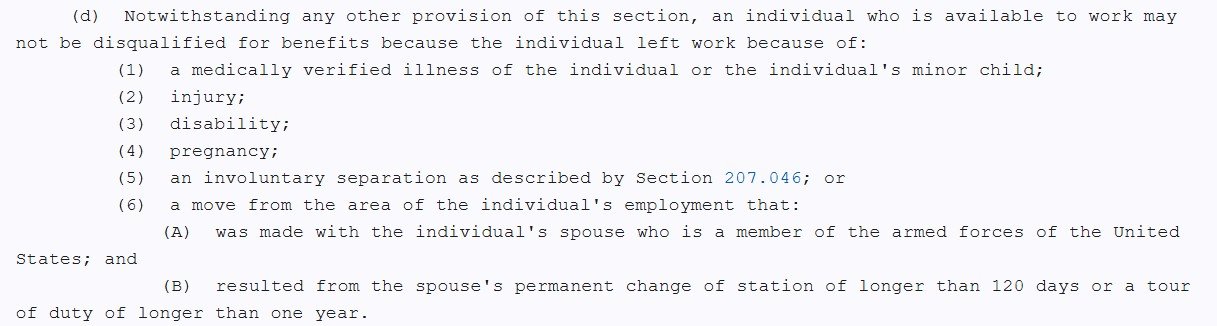
Source: Texas Labor Code §207.045
The statute shown above identifies the types of conditions where a claimant is eligible for benefits. It does not add a test to the language requiring a doctor to tell a claimant to resign, and lawmakers would have included the instruction if it were their intent.
“Whether an individual formally quits her job for medical reasons or goes on medical leave, section 207.045(d) ensures that she is not disqualified from benefits if she otherwise meets the Act’s requirements.”
-Texas Workforce Commission v. Wichita County (2018)
Three Levels of Review
The Appeal Tribunal stage involves sending documents to add to the record, providing any witnesses, and identifying other materials that may be relevant to the claim.
The Appeal Tribunal ruled in favor of the claim. In justifying its decision, the Tribunal relied on Commission precedent (Appeal No. 1206-CA-74), which states that when a claimant is separated from work due to illness or disability and has properly kept the employer informed of their condition, the separation is not considered voluntary under Section 207.045. No disqualification is imposed in such cases.
TWC, as the employer, appealed the decision to the Commission. The case was then reviewed by the three Commissioners. The case was ordered for a rehearing, and information gathered would be sent back to the Commissioners for review. Part of the agency's argument against the affirmative finding at the tribunal level included statements concerning previous precedent. In its appeal to the Commission, TWC argued the Tribunal’s use of Appeal No. 1206-CA-74 was incorrect because the precedent was pregnancy-related and required the claimant to be physically unable to perform the job, whereas the claimant in this specific case was found to be physically able to work and had not been advised by a doctor to resign.
Information from the hearing was provided to the Commission, where the previous ruling was overturned by a majority vote. Among the reasons for the Commission’s decision was that a doctor had not advised the claimant to resign, the same factor cited in the initial determination.
The final option was a request for a rehearing. The Commission denied the motion without explaining why it fell short of the rehearing criteria.
Judicial Review and the Substantial Evidence Standard
Once administrative options close, a claimant may seek judicial review in court. It is an uphill climb to receive an affirmative decision in court due to the substantial evidence standard. The agency is already in a position where the court defers to the final administrative ruling unless the substantial evidence standard is not met. The court does not conduct a full review of the evidence. A full definition of the substantial evidence standard (also used at the district level) is found below, along with an appellate court decision of a past claim detailing how a judicial review is conducted:
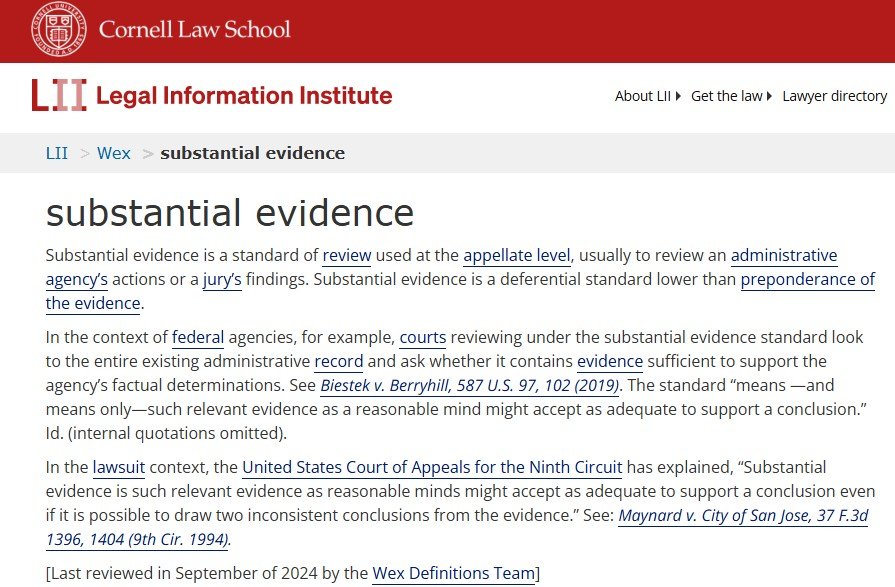
Definition from Wex, Legal Information Institute, Cornell Law School.
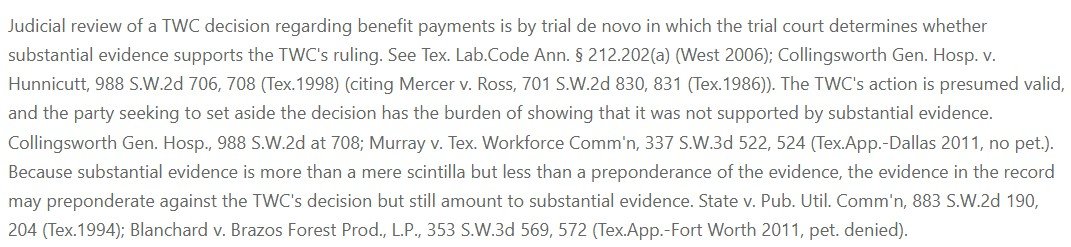
Spicer v. Texas Workforce Commission, No. 02-13-00433-CV.
Why This Issue is Important to Policymakers
This situation demonstrates statutory language regarding "good cause connected with the work" exists, but there is inconsistency in its application. Across the levels of review in this claim, decision-makers weighed medical documentation differently. Some in the agency look at medical situations with the broader view of a person having problems and doing their best to address a workplace challenge, and others apply a more narrow standard of needing certain paperwork at specific times. These decision frameworks collide on a regular basis and ultimately cause confusion and inefficiency.
The physician-directive test does not appear in Section 207.045(d), yet it was cited at two of the decision points in this claim: the initial determination and the Commission’s final decision. At the individual level, this leads to ambiguity, uncertainty, and stress. At the agency level, it continues to cement the use of unclear policies and commits more resources that could be used elsewhere if there was clear statutory guidance.
Subsequent review of Commission meeting records found the same question appearing in multiple voluntary-separation cases involving medical conditions, which became the subject of a separate comment submitted to the Sunset Advisory Commission.
A second structural question involves claims filed by TWC’s own former employees. In those cases, the agency is both the employer contesting the claim and the body deciding it. Policy Field Notes addressed this issue in a rule review comment on 40 TAC Chapter 815.
Conclusion
I value policies and rules that are properly applied to all individuals. My hope in pulling this information together is to inform the highest decision-makers of what is occurring at the agency and advocate for policy changes.
For a factual study on these types of Commission decisions, please read my upcoming analysis on this issue. The research focuses on what the law states regarding voluntary leaving, how the Commissioners are not in agreement on what constitutes a good cause quit, and how this remains a lingering issue at the agency. How often does the physician-directive test appear in Commission decisions, and what would clearer statutory guidance look like?
For background on how unemployment insurance works as a federal-state program, see Unemployment Insurance, Part I.
About the Author
Blake Dodd is a policy analyst specializing in workforce programs, regulatory interpretation, and state program evaluation. He has experience advising on funding decisions affecting colleges and employers, with a background in legislative research and budget support in Texas and Louisiana. His writing focuses on how governmental systems implement policy and the importance of alignment with the original intent of a law or regulation.
Follow along on X, LinkedIn, Facebook, and Instagram, and subscribe below for new field notes and analysis.
Update: This article was revised on September 28, 2026 to focus on the statutory standard and the levels of review, and to remove personal details not needed for the analysis.